What is most important in games? Rules? Well, certainly. You need rules to establish your boundaries. Style? Style can mean many things, but I’m talking about art specifically and I think it’s pretty important for a game’s art to be eye-catching and theme appropriate. But something that might get overlooked more easily by the amateur game developer is Action. When it comes to developing a game I find it to be pretty important to consider the Action of my game.
And, no, I’m not talking about Action like a sequence in a movie or videogame. I’m talking about the physical movement within the game, like the Action on a guitar, the feel of the game. Does it feel right? If you’re developing a board game and you make all your rules and components, and, if you’re more talented than I, art, it’s all for nothing if you go to play the game and it doesn’t feel satisfying.
You may still be wondering what the heck I’m talking about. Let me give you an example. Have you ever played poker? I haven’t. Well, not in any serious capacity anyway. It’s not my kind of game. But you know how in movies there’s always that scene when someone says, “read ’em and weep,” and they lay down their hand triumphantly and start raking in the chips, but then some other person at the table goes, “ah, ah, ah,” and flips over one of their cards that until then had been face down and the dealer’s all like, “twenty-one wins,” in their cool, collected, disconnected from all emotion voice and the whole thing erupts in gun violence.
I know what poker is.
But what I’m talking about is the Action of the game. It’s that point where you throw down that card, or count your pawn hops to victory, or, in more of a slow burn kind of way, when you roll your attack in D&D and then add up your bonuses. I think it is a part of games that everyone experiences, but not everyone really considers its significance in their gaming experience.
A little personal history. I first started trying to develop games about eleven years ago. I mostly focused on card games, but I wanted to give them enough depth to make them interesting. I worked on quite a few of these games over the years, the vast majority of which died in development, and more often than any other reason it was because when I tested them out they just weren’t as satisfying as I thought they would be. Maybe that card passing concept felt tedious, maybe players had too few options (or too many!), maybe it just wasn’t a good game. Ultimately, I bailed on these projects because I didn’t know what to do. Fixing an issue like this would typically require revamping the entire game, which would leave me scratching my head, because what do you do when your core mechanics just don’t feel right? Sometimes quitting is just necessary.
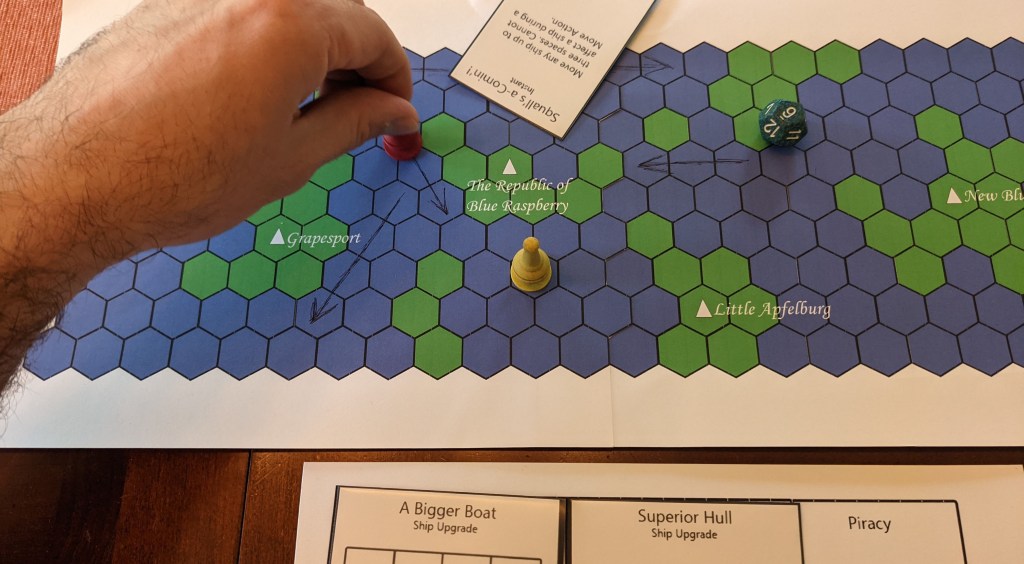
Recently I began work on the game for which this blog was created and I’m going to tell you a little about it now. I am currently calling the game Cutthroat Fruit Merchant. It’s already gone through several changes as I’ve slowly been testing it with friends. But I think even from the first time I tested it the Action felt pretty good. CFM is built on a hex-grid map and each player controls a single pawn representing their ship. When I first tested out the basic movement system with my fiancé we only played for about twenty minutes, but we both walked away from it feeling like something was right. It wasn’t perfect, but it was the beginning of something.
OK, maybe that description sounds a little too “eye-opening” or too “enlightening”. I mean, chances are if you play board games you’ve played a game that works in a similar way. This movement thing is nothing new. But the fact that the movement between destinations feels meaningful and important is critical! This can easily be botched if movement is too easy or too difficult. And I’m not saying this system was perfect either. It changed. Within another test or two we added in favorable winds that allowed you to get across the board a little faster if you followed certain routes. It gave the game a sort of Chutes and Ladders quality that made movement feel even better!
There’s also a combat mechanic, because where there are ships there must be pirates. One player can make an attack against another player. An attack is made by rolling the die, which always feels good, and adding bonuses. Additionally, players from both sides may have instant use cards that can temporarily increase or decrease bonuses on either side of the combat, so you get that throwing down cards Action. This mechanic also had a pretty good feel right away, but went through some changes too. It was suggested by my good friend Moss that instead of the defending player simply having a defense stat, they could counter roll and then add bonuses to determine their defense. While this was only tested in one game it was a lot of fun! It felt more like an actual battle where players could sort of trade blows. We also made it so that if the defending player out-rolled (plus out-bonused) the attacking player, the attacking player could get sunk from the combat they initiated. It made these battles more dynamic and risky and overall it made the Action feel better!
So what’s the takeaway? Everyone is going to have different things they like in games. Some people like cooperative games, some like competitive, some people like rules, and others like a game just for its art. But in my opinion, a game isn’t going to have a lot of staying power in my rotation if it doesn’t have a good Action. And this doesn’t have to be constant in a game. Sometimes the build up to that moment is the most important part. The look on your friends’ faces when you throw down that card and turn the tide of the game is probably the part you’re going to keep talking about. And that to me seems pretty relevant when it comes to making a good game.
 Tastefully Done Games
Leave a comment